Listing Directory: Post Your Need

  • Azmi Abu Daqqah

    Azmi Abu Daqqah

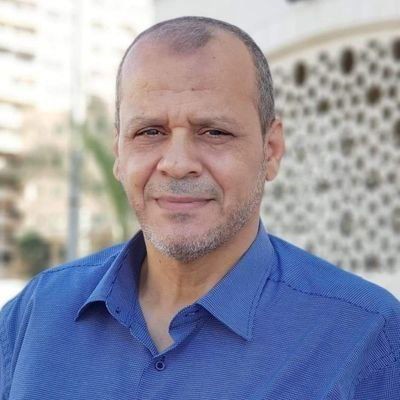
    Dr. Azmi Abu Daqqah (‘Azmi Abū Daqqah) (عزمي أبو دقة) was a lecturer and head of the Center for Environmental and Chemical Analysis at the Islamic University of Gaza (IUG). He was also chair of the Board of Directors of al-Birr Charitable Society.

    Dr Abu Daqqah obtained his PhD from IUG in Microbiology. He worked in the darkest of circumstances and risked his life many times to feed the hungry and meet their needs. He did not hesitate to do charitable work even during Israel’s 2023 aggression, as he managed several camps that housed hundreds of displaced people. In his farewell to his son who was killed he said: “We are not the exception among people. We push our sons to the front lines.”

    Dr Azmi was killed on the morning of Saturday 18 May 2024 when his car was struck by a bomb or shelling in the southern Muhrarat area between Khan Yunis and western Rafah. 

    Photo credits: Facebook; X

  • Mahmoud Abu-Duff

    Mahmoud Abu-Duff

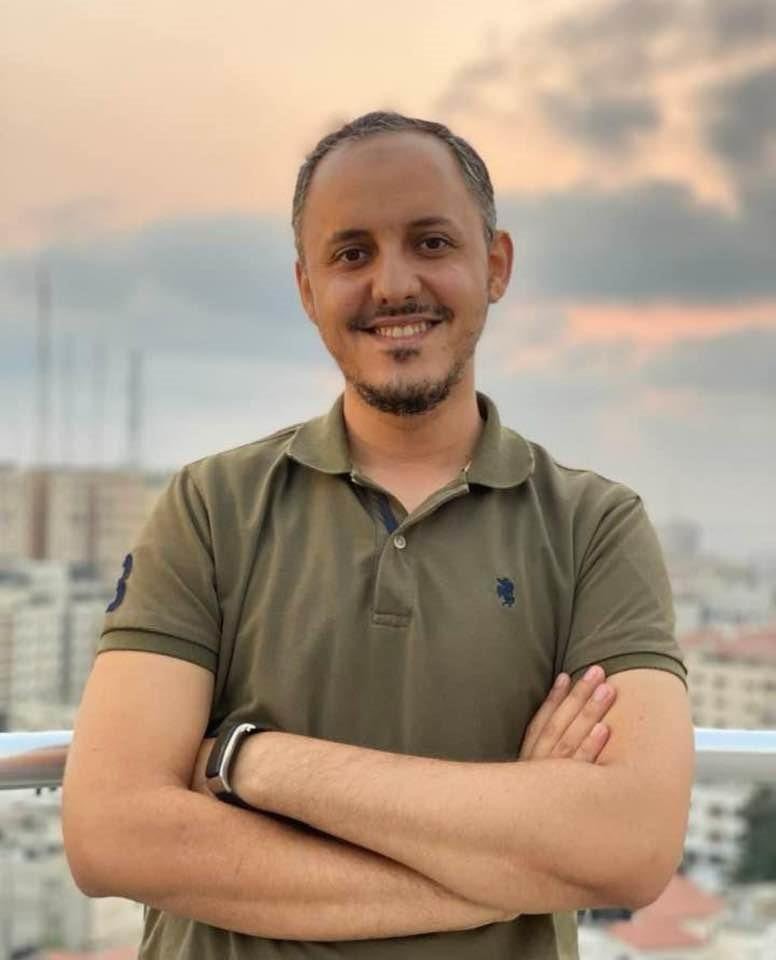
    Mahmoud Abu-Duff (Maḥmūd Abū Duff) (محمود أبو دف), age 62, was a teacher and administrator dedicated to improving the educational experience of Palestinian children. He was a Professor of Education and former Dean of the College of Education at the Islamic University of Gaza, as well as Chief Editor of the Journal of Education and Psychological Studies published by the university. 

    Dr. Abu-Duff received his BA in Education (Arabic Language) from the Islamic University in Gaza in 1985. He was awarded an MA in Fundamentals of Education from the University of Omdurman, Sudan, in 1989.  He earned his PhD in Education from the same university in 1993. 

    Dr. Abu Duff was an active researcher, who attended conferences and published papers in the field of education, focusing on Islamic education and teacher training. In addition to a number of academic articles published in Palestine, Egypt, and Jordan, he authored a book, Introduction to Islamic Education, which was published by Afaq Printing and Publishing House, Gaza, in 2002. He also edited An Introduction to Islamic Education: The Manifestation of Negative Change in Contemporary Muslim Reality According to the Prophet’s sunnah, and How to Address it in Light of Islamic Education, published by the School of Education, the Islamic University of Gaza in 2004.

    When Dr. Abu-Duff served as chair for the conference on “The Palestinian Child between the Challenges of Reality and Future Aspirations” in 2005, he welcomed the participants by speaking to the necessity of providing a quality education for Palestinian children that can guide them toward a brighter future. He shared his vision for the College of Education as one of contributing to the education of a Palestinian individual based on faith, knowledge, and the skills capable of keeping pace with development, facing challenges, and participating effectively in building their society. 

    Dr. Abu-Duff was killed alongside his wife, Dr. Khitam al-Wasifi (see bio in this archive), when their home in al-Zaytun, Gaza City was hit by an Israeli missile strike on 1 December 2023.

    Photo credit: Gigaza

  • Fadil Khaled Hussein Abu Hein

    Fadil Khaled Hussein Abu Hein

    Fadil Abu Hein (Faḍl Abū Hayn) (فضل خالد حسين أبو هين) was a professor, researcher and psychologist at al-Aqsa University for more than 20 years. He was a beloved teacher and a prolific scholar with a distinguished career as a psychologist-practitioner. He was an expert in treating trauma and the mental health effects of exposure to violent conflict and war, and he worked hard to de-stigmatize mental health treatment in Gaza. 

    Dr. Abu Hein grew up in Gaza City where he lived in al-Shujaʿiyya neighborhood. He earned both his master’s and doctorate degrees from the Department of Clinical Psychology at Ain Shams University, Cairo. When he returned to Palestine, he took up a teaching position in the Psychology Department at al-Aqsa University in Khan Yunis. For some years he also served as department head. He had a parallel career as psychotherapist and professional trainer-supervisor through work he conducted at the Center for Psychological Counseling and Human Development and as director of the Community Training Center for Crisis Management, both in Gaza. And he shared his expertise in multiple ways and with diverse audiences: he routinely attended academic conferences and professional meetings in Europe and elsewhere, and spoke on popular Palestinian talk shows to respond to questions about psychological challenges. 

    He had his own, personal experience with violence. In 2003, he was arrested by Israeli forces during a military incursion in al-Shuja`iyya that resulted in 13 Palestinians being killed, among them his three brothers. His family home was later razed to the ground by the Israeli military. 

    Fadil Abu Hein has numerous publications, most of which appear in al-Aqsa University’s Journal of the Humanities. His early publications, beginning with his 1985 master’s thesis, describe mental health symptoms of segments of the Palestinian population in Gaza. Later publications address scientific studies he undertook and their findings regarding the effects of specific forms of violence. For example, a 2001 article discusses the psychological effects on Palestinian children of house demolitions carried out by Israel; a 2006 article treats the psychological effects of captivity and torture and their impact on coping strategies of Gazans released from Israeli prisons. Another set of publications identifies a particular ‘episode’ in the long trajectory of conflict and violence – the al-Aqsa Intifada (2000-2005) – and considers psychological variables and effects. For example, two articles published in 2001 investigate the choice among Palestinian youth to participate in the Intifada and its relationship to their sense of self-esteem. 

    During and following the Israelis’ three-week military offensive from 27 December 2008 to 18 January 2009, Fadil Abu Hein and his colleagues interviewed 950 families, among them 2,180 children, across Gaza, and found that a majority of children displayed signs of trauma. Once a ceasefire took hold, teams from his center went into areas most affected by the onslaught to provide children with emergency counselling. Of this violent episode, Abu Hein insisted at that time — more than 15 years before the present, ongoing genocide — that it had inflicted more severe trauma than previous conflicts in Gaza because civilians did not have a “safe zone”. In an interview in 2022 he indicated that “[I]t is difficult to provide psychological treatment because Gaza lives in a changing reality…” 

    Fadil Abu Hein was killed by a sniper on 23 January 2024. He was in Khan Yunis when Israeli forces besieged the city. He was 66 years old. 

    Learning of his death, colleagues and students shared moving tributes, among them: “…My heart breaks for the life he has endured, the dignity he displayed and his unnecessary death…. a huge loss to the people of Gaza.”


    Photo credit: Gigaza

  • Salem Abu Mukhdah

    Salem Abu Mukhdah

    Salem Abu Mukhdah (Sālim Abū Makhadda) (سالم أبو مخدة), age 52, was an active scholar of Islamic law who published broadly on issues of Islamic legal doctrine and practice relevant to contemporary times. He served as an educator for many years, first as a teacher in Gazan schools and later as an associate professor, lecturer, department head, and vice-dean at the Islamic University in Gaza. He was a scholar-teacher who made significant contributions to his field as a researcher, instructor, and administrator.

    Dr. Abu Mukhdah was born in the Gaza Strip in 1971 and completed his primary and secondary education in Gazan schools. He received a bachelor’s degree from the Faculty of Shari`a in 1995, a general diploma in education from the Faculty of Education in 1997, and a master’s degree in 2006 from the Faculty of Shari`a and Law in the field of Shari`a Jurisprudence, all from the Islamic University in Gaza. He earned his doctoral degree in 2012 from the Faculty of Arts and Humanities in the field of Comparative Jurisprudence from Janan University in Lebanon, with a thesis entitled, Rulings on Dealing with the Enemy in Islamic fiqh: a Palestinian Case Study. 

    Dr. Abu Mukhdah worked as a teacher for the Palestinian Ministry of Education from 1998 to 2008. After completing his MA degree, he became a lecturer at the Faculty of Shari`a and Law at the Islamic University in Gaza in 2007. Once he completed his doctoral degree, he was tapped to become Deputy Dean of the College of Shari`a and Law for Scientific Research and Postgraduate Studies at the Islamic University from 2012-2013, and head of the Department of Islamic Shari`a at the Faculty of Shari`a and Law from 2013-2015 and again in 2018. He was also a member of the Fatwa Committee at the Islamic University from 2015 to the time of his death.

    (Dr. Abu Mukhdah, second from left)

    Dr. Abu Mukhdah was author and co-author of some 40 academic articles and posters on issues arising in contemporary Islamic legal doctrine and practice related to family relations, religious ritual, education, and business arrangements. Among them: “The extent of the judge’s authority in consensual and judicial khul`” [female-initiated divorce], published in the Journal of Islamic Sciences, Faculty of Islamic Sciences, Iraqi University, in 2019, and “Divorce of the Psychiatric Patient in Islamic Jurisprudence,” published in the Journal of Research and Sharia Studies in the Arab Republic of Egypt, in 2017. 

    Dr. Abu Mukhdah was killed along with his entire family by an Israeli airstrike that came without warning on his home in Dayr al-Balah on 18 October 2023.

    Photo credits: IPS; Facebook

  • Nasser Abu El-Noor

    Nasser Abu El-Noor

    Dr. Nasser Abu El-Noor (Nāṣir Abū al-Nūr) (ناصر أبو النور) was a distinguished Palestinian nurse, academic, and health policy expert whose life was dedicated to the advancement of nursing education and the improvement of health care systems in Gaza and beyond. Dr Nasser served as Professor and Dean of the School of Nursing at the Islamic University of Gaza, where he was a central figure in developing clinical education and health research for over two decades.

    Born in the al-Geneina neighborhood of Rafah in the southern Gaza Strip on 22 May 1964, Dr. Abu El-Noor attended local schools in Rafah before pursuing his passion for health care. He earned his bachelor’s degree in nursing from al-Quds University College of Nursing in 1996. Driven by a commitment to both practice and policy, he pursued further studies abroad, receiving his Master of Arts in Nursing Administration from Marquette University in 1998 and his PhD in Health Care Policy from the University of Akron in 2010.

    His early career began as a general nurse at the Arab National Hospital in Gaza, where he worked from 1990 to 1997, eventually becoming a senior nurse. In 1996, he joined the Islamic University of Gaza as a clinical lecturer in the Faculty of Nursing. Over the years, he rose through academic and administrative ranks, serving in multiple leadership roles including Head of the Clinical Practice Department (2010–2011), Chairman of the Quality Improvement Committee (2011–2012), and Chairman of the Planning Committee (2012–2014), before ultimately becoming Dean of the School of Nursing.

    Dr. Abu El-Noor was a prolific scholar, having authored and co-authored over 70 academic articles in English focusing on health care policy, nursing practice, post-traumatic stress disorder, and end-of-life care, areas of profound relevance in conflict-affected regions like Gaza. His work reflected a deep commitment to addressing the psychological and systemic challenges faced by patients and health care providers under siege and occupation. He was the editor of the Journal of Health Care and Prevention.

    Dr. Nasser Abu El-Noor was killed on 21 February  2024, along with his wife, five children, and granddaughter, when an Israeli airstrike targeted their home in the al-Geneina neighborhood of Rafah.

    Dr. Abu El-Noor is remembered not only for his academic and professional achievements, but for his steadfast dedication to his students, his community, and to the human right to health and dignity under even the most difficult circumstances.

    Photo credit: X

  • Somaya Abu Oun

    Somaya Abu Oun

    Somaya Abu Oun (Sumayya Abū ‘Awn) (سمية أبو عون) was a teaching assistant in the College of Pharmacy at the University of Palestine. According to her Curriculum Vitae on the University’s website, she taught General Physics Laboratory A and B. She had a BS in physics from the College of Science, the Islamic University of Gaza. 

    She was 33 years old and married to Basel Alhaj (see his bio in this archive), when they were both killed with many other relatives, after the Israeli air force struck their house in the Nusayrat Refugee Camp in Dayr al-Balah Governorate on 20 November 2023. They left behind their third-grade daughter, Jana, and a barely two-year-old son, `Abd al-Rahman. A post on the account gaza_shaheed on X dedicated to those who were killed by the Israeli army memorializes her with the following words: “[Somaya] was known for her kindness and her love of learning. She was a perfectionist and worked hard at whatever task she chose. Thanks to her character and her dedication, she became a good example for many to follow.”

    Photo credit: X

  • Wael Abu Quffah

    Wael Abu Quffah

    Wāel Abu Quffah (Wāel Abū Quffah) (وائل أبو قفة) was one among at least 189 journalists and media workers killed by the Israeli military in Gaza. He worked as a sound editor at the educational Quran Karim Broadcast-Voice of the Islamic University of Gaza. His name appears on many of its programs. The Broadcast’s graduates come mainly from specializations in journalism and media (Faculty of Literature) and proselytizing and media (Faculty of Fundamentals of Religion), after receiving training in program preparation and presentation, broadcast engineering, and sound editing.  

    According to a message from his daughter to the account gaza_shaheed on Instagram, Abu Quffah received an MA in Digital Media from the Islamic University of Gaza and was in his third year working toward his PhD. And, she adds, prior to his graduate studies, he had done three years of academic work at the University of Mostghanem in Algeria. 

    An Israeli strike on the family house in the Nusayrat Refugee Camp in Dayr al-Balah Governorate, on 22 November 2024, took the lives of Wael and his thirteen-year-old son Emad (`Imad). Israel did not allow foreign journalists to enter Gaza to cover its invasion of the Strip, which made it easier to target Palestinian journalists. 

    The Palestinian Media Forum mourned their member’s murder in a statement that acknowledged Abu Quffah’s dedication in airing the suffering of the Palestinian people, and pledged to continue this mission. The Forum reminded the hard-of-hearing international community to act to put an end to the unprecedented Israeli slaughter of Palestinian journalists, which undermines their right and ability to perform the professional duties accorded to them by international law and humanitarian conventions.

    The Committee to Protect Journalists (CPJ) in New York, reported that its preliminary investigations indicated that 189 journalists and media workers in Gaza were killed by Israel as of 8 October 2025. And it pointed out that Israel has killed more Palestinian journalists than were killed worldwide in the period 2020-22. In a statement regarding the slaughter of Palestinian journalists, the CPJ called “on the international community to hold Israel to account for its unlawful attacks on journalists; ensure international media is given immediate, independent access to Gaza; and open humanitarian corridors for journalists.” 

    In the above-cited message by his daughter, she included this personal note about him: “My father was very caring toward his daughters, generous with those he loved, and forthcoming with those who called on him.” And one of `Emad’s sisters posted this note on the account @gaza_shaheed, on X, “My brother `Emad was liked by everybody, and he liked children… and he tried to respond to anyone who approached him. `Emad departed from this world, but not from our hearts.” 

    (Wāel’s thirteen-year-old son `Emad)

    Photo credits: Facebook; X

  • Ismail Abusaada

    Ismail Abusaada

    Ismail Abusaada (Isma‘il Abū Sa‘adah) (إسماعيل أبو سعدة) was a scholar and academic administrator with interests in promoting business and entrepreneurship among Gaza’s young people, in spite of the Israeli blockade. He was on the international faculty of the International American University and served as its Gaza academic coordinator.

    Abusaada was born in the United Arab Emirates, where he received his secondary education. His family returned to Gaza, where he completed a BA and MBA in Business Administration, both from the Islamic University of Gaza (IUG). His master’s thesis was a case study of a new entrant in Gaza’s dense higher education infrastructure, the University College of Applied Sciences. 

    During this time, he was also active in the NGO space, serving as an advisor to a large humanitarian organization and the CEO of the Youth Media Center. In 2015, the Center along with other NGOs held a one-day conference at the Commodore Hotel in Gaza City, featuring several prominent Gaza journalists who were able to transcend the territory’s isolation and develop broader name recognition and professional success.

    Abusaada then traveled to Malaysia to work on a PhD in business administration at the International Islamic University of Malaysia. His 2022 dissertation uses political economist Sara Roy’s framework of “de-development” to diagnose how Gaza’s Israeli-engineered debility affects the local private sector, and develops a model of business sustainability in the face of this uncommon economic reality. 

    A spin-off article, “The Challenge for Business Owners in the Gaza Strip,” argues, “The literature assumes that periods of instability are followed by periods of stability. Furthermore, the literature on instability never considers the unique case of one country with absolute military control trying to “de-develop” another country. Thus, the authors propose that a new term be coined, namely “prolonged instability.” 

    Dr. Abusaada returned to Gaza to teach business students enrolled with the Los Angeles-based International American University. Of the thesis defense of several Palestinian MBA students, he posted on his LinkedIn, “It’s fascinating when you see your students reaching their final destination and delivering excellent presentations for their thesis [sic]. Also, you feel proud with other students when you examine their thesis and find a lot of effort and outstanding achievement.”

    On 5 December 2023, Dr. Abusaada was killed in an Israeli strike (some sources indicate it was sniper fire). A friend remembered him on X, “I don’t know anyone who met you and didn’t love you. May God have mercy on you, O pure of heart and virtuous qualities.” 

    The al-Jazeera correspondent Tamer Almissḥal, who had attended the 2015 journalism conference, paid tribute on X, “May God have mercy on you, the creative martyr and energetic son of Gaza, Dr. Ismail Abusaada.” 

    Photo Credit: X

  • Nesma `Adil Abu Sha`ira

    Nesma `Adil Abu Sha`ira

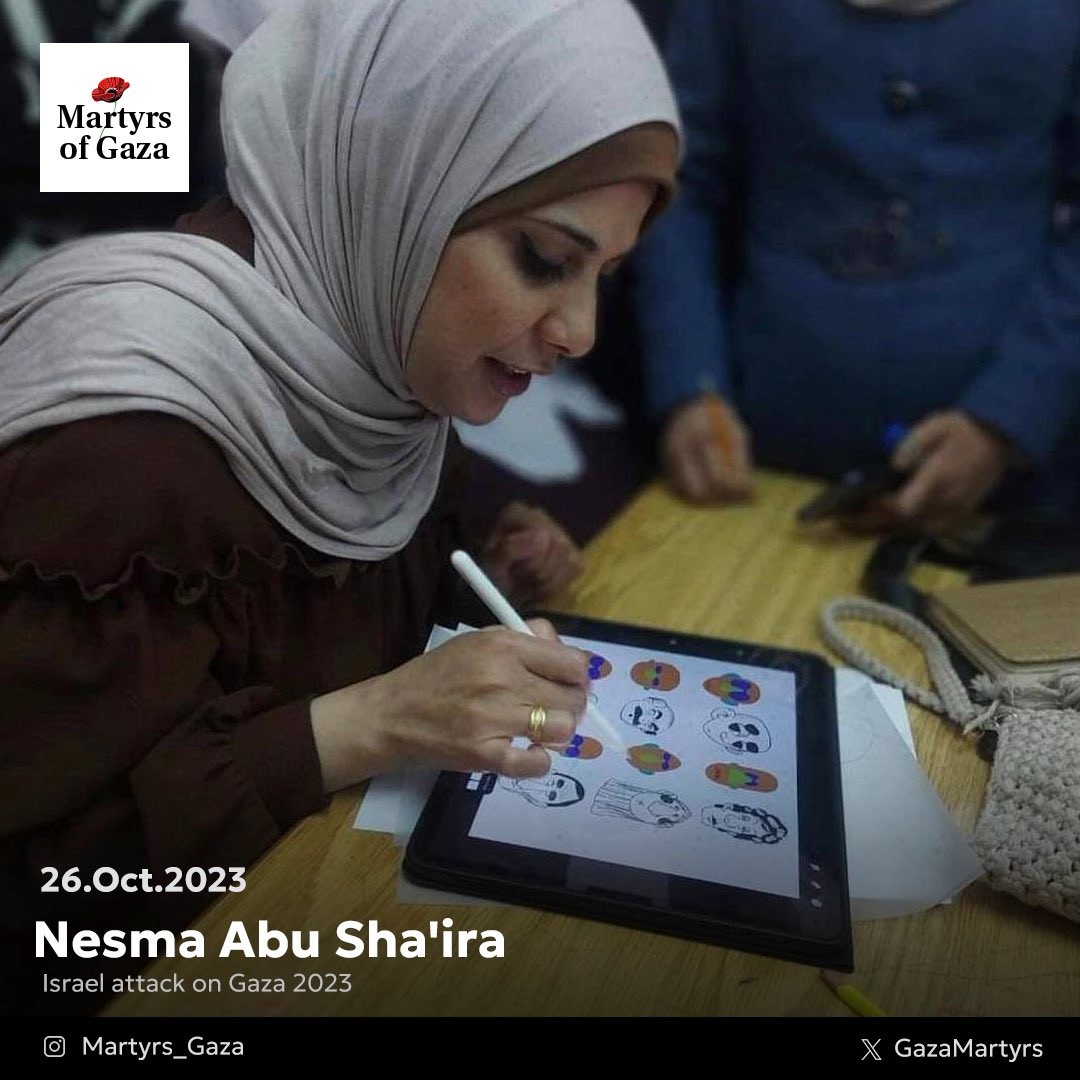
    Nesma `Adil Abu Sha`ira (نسمة عادل أبو شعيرة) was an artist and lecturer in the Department of Fine Arts and Graphic Design at al-Aqsa University. In February 2023, eight months before her untimely death, she was appointed Assistant Head of her department. 

    Nesma Abu Shaʿira was born on 26 April 1987 and lived in Gaza City. She earned two Bachelor of Arts degrees – in Fine Arts and Architecture, and in Clinical Nutrition – both from al-Aqsa University in 2011. In 2018, she completed a master’s degree from the College of Education at Islamic University of Gaza, with a specialization in General Curricula and Teaching Methods. Her MA thesis addressed the question whether developing artistic design skills benefits significantly from training in improving students’ visual intelligence. Nesma Abu Shaʿira conducted a controlled experiment between two groups of female students in the Faculty of Fine Arts at al-Aqsa University. She concluded that those who had followed coursework with systematic training in both perceiving and manipulating visual details had demonstrably more sophisticated design skills than those who had not.

    As an artist, Nesma Abu Shaʿira especially enjoyed creating character sketches of mystical creatures and characters from books. However, her Instagram account was her gallery, where she exhibited the range of her artistry and creative production. At the time of her death, she was engaged in a few different projects; she was creating illustrations for a children’s book, as well as a new series of artworks “documenting Palestine” in her own way. Abu Shaʿira was a recognized artist: in 2011, for example, she won third place in the first Gaza Contemporary Art Festival. 

    As a teacher and pedagogue, Professor Abu Shaʿira was very proud, especially of her female students, in whom she saw “a bright future.” She routinely posted her students’ artwork on Instagram, especially their storyboards which she considered a compelling medium for sharing the Palestinian story. She was loved by her students who, in their tributes, spoke of her in glowing terms: 

    “I never imagined that one day I would share my sorrow and exhausted feelings, and experiences that will never be lost from my memory, like the departure of my teacher, for example.”

    ‏“My beloved teacher, Nesma Abu Shaʿira, or as we always called her, ‘Miss Nesma’ – the one with the tender heart and the gentle, kind influence. My former teacher at the College of Fine Arts excelled in her field and always aimed to do her very best. I used to consider her my role model and I regarded her as my favorite artist.”

    “Our last encounter was during the discussion of my graduation project…. I will never forget the sparkle in her eyes and her pride in her student at that moment.”

    “It breaks my heart, truly, to lose you. We will never have another teacher like you!”

    “It’s difficult for me to say that she was and remains in the past, but God is my witness that she is always in my heart and prayers.”

    Nesma Abu Shaʿira was killed with her daughter, Habeeba (Habība), on 28 October 2023 when an Israeli airstrike hit her home in Gaza City. She was 36 years old.

    Photo credits: Our Gaza; Untold Palestine

  • Khalil Abu Yahia

    Khalil Abu Yahia

    Khalil Abu Yahia (Khalīl Abū Yahyā) (خليل البطش), aka Khalil al-Baṭsh, 27, was a scholar, activist, and an organic intellectual. He dedicated his truncated life to cognitive liberation from colonial mental models and from Zionism’s epistemological erasure of Palestinians. 

    Abu Yahia worked as a public school English teacher and a freelance English translator. In September 2023, he was appointed a lecturer in the English Department of the Islamic University of Gaza (IUG).

    He began engaging with postcolonial English literature at al-Aqsa University, where he earned a BA in 2018. It was there that he fell in love with the writings of Edward Said, Frantz Fanon, and Ghassan Kanafani, as he chronicled on his Instagram page. College was also where he became an activist with the Boycott, Divestment, Sanctions (BDS) movement, which he advocated until his last days. 

    His mentor was Dr. Haidar Eid, professor of postcolonial literature, with whom he would develop a close collaboration. They worked on an oral history project interviewing 21 Nakba survivors in Gaza. They also produced a short film titled “Returning to Zarnouqa,” recalling the village from which Eid’s parents were expelled in 1948.

    Eid and Abu Yahia were active in Gaza’s Great March of Return (GMR) protests, the huge weekly gatherings that lasted for nearly two years (2018-2019). The protests called for an end to Israel’s ruinous blockade on Gaza and asserted Palestinians’ inalienable right of return to the homes from which they were expelled in 1948.  

    The only time Abu Yahia left Gaza was in 2019, when he traveled to East Jerusalem for spinal cord cancer surgery. Availing himself of the rare opportunity to see the rest of Palestine, he made a pilgrimage to Ghassan Kanafani’s house in `Akka (Acre). Standing in front of the home, Abu Yahia wrote, “I hope to live for the day when my friends and I from Gaza can visit Ghassan’s house without Erez or occupation or colonialism (to hell and the dustbin of history).”

    By this point, Abu Yahia was working toward his master’s degree in linguistics and translation at IUG. He also honed other kinds of research-based writing, including a deeply reported feature story with two Israeli coauthors on how Israel’s blockade undermined Gaza’s potential to build climate resilience.

    In 2022, he earned his MA from IUG with a thesis titled Decolonizing The Nation through Translation: A Critical Discourse Analysis of Anti-Colonial Palestinian Narrative. The thesis shows how Palestinian translators leave an intentional mark in their works, reconstructing rather than merely transmitting texts to put forward a vibrant Palestinian counter-narrative. 

    Ten days into Israel’s 2023 assault, Abu Yahia told an interviewer: “I fear that I will die without achieving my dreams. I want to complete my PhD. I want to rebuild my family’s house.” And he reiterated his commitment to BDS: “When every government boycotts this colonial system, it will be isolated. And that’s how it will end.”

    On 29 October 2023, Khalil Abu Yahia was killed by an Israeli airstrike on his in-laws’ home in al-Zawayda in central Gaza, along with his wife Tasneem Thabet and their two baby daughters, Elaf (2) and Retal (1). At least 17 other family members also perished.

    Tributes poured in from all over the world, remembering a luminous mind cut down in its prime. Dutch university students named their protest encampment in Abu Yahia’s honor. A student at the University of Bologna dedicated his thesis to him. And editors of Jewish Currents eulogized Abu Yahia’s “unfettered imagination.”

    Photo Credits: Chuffed; Instagram